
Why Your AI Chatbot Makes Up Numbers (and What an Executed Answer Looks Like)
Try this on any popular AI chatbot: "What's Apple's RSI right now, and would a mean-reversion strategy have beaten buy-and-hold on SPY in 2022?"
You'll get an instant, fluent, precisely quantified answer. A specific RSI value. A specific return figure. Maybe even a Sharpe ratio, to two decimal places.
Almost all of it is fiction.
Not because the model is broken—because it is doing exactly what it was built to do: produce plausible text. A large language model generates answers; it does not fetch prices, run backtests, or compute indicators. When a finance question demands a number the model never saw in training, it improvises one with the same confident tone it uses for everything else. In investment research, a fluent wrong number is more dangerous than an honest "I don't know."
1. Knowing Isn't Computing
The deeper problem isn't accuracy—it's that a chatbot's answer cannot be verified or reproduced. There is no engine behind the number, no methodology you can inspect, no way to ask "run that same test with a 14-period RSI instead." A generated answer is a dead end; an executed answer is the start of an analysis.
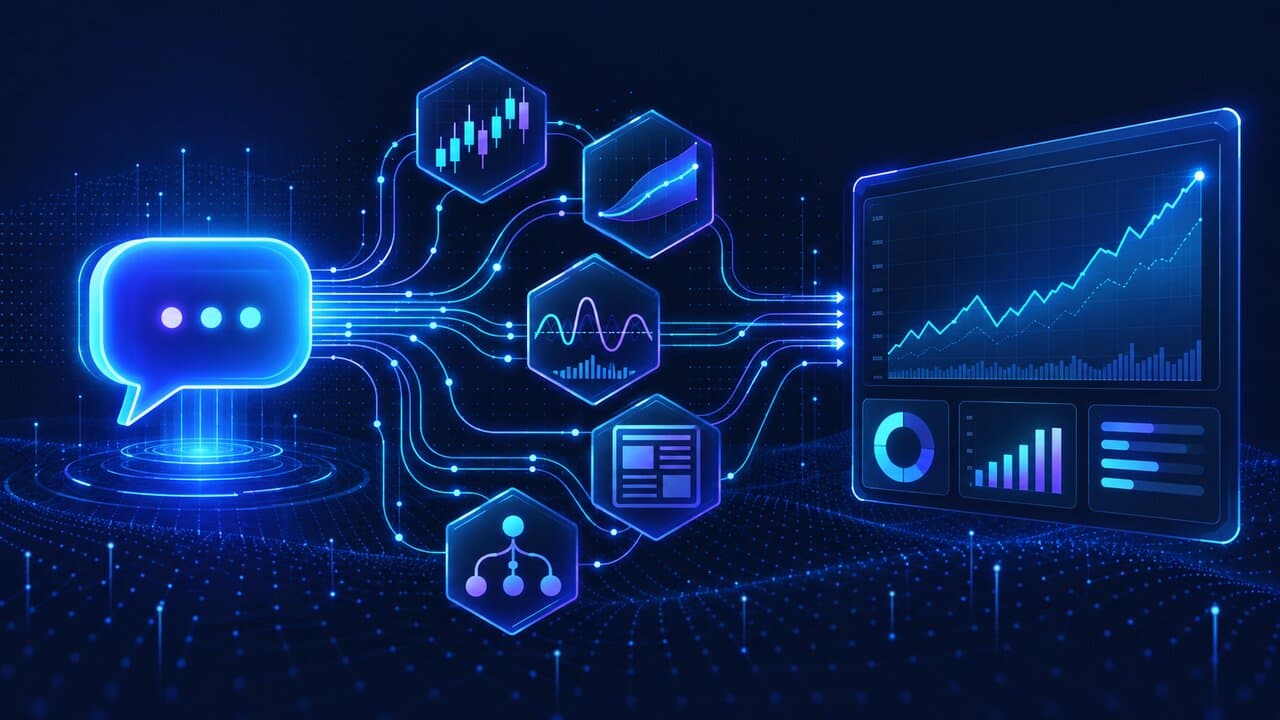
This is the gap agentic chat closes. Instead of answering finance questions from memory, an agentic assistant routes each request to the production engine that actually computes it—the same engines powering the platform's charts, backtests, and research workflows—and returns the engine's output, with its parameters, as the answer.
2. Anatomy of an Executed Answer
Consider what happens when you ask IntelCast's Agent mode the SPY question from the opening. Rather than composing a plausible-sounding backtest, the agent:
- Recognizes intent: this is a strategy backtest, not a data lookup.
- Dispatches to the backtesting engine: the same production engine behind the strategy dashboard.
- Returns real output: SPY buy-and-hold for 2022: about −20.6%. Then it runs the variant you asked for—an RSI mean-reversion rule on the same period: roughly −6.3%, cutting the drawdown year's loss by more than two-thirds.
Here is the part that matters: those figures are identical to the runs in your dashboard. Not similar—identical. Same engine, same data pipeline, same result whether it arrives through a chat bubble or a form. And because it's a real engine run, you can follow up conversationally: "Now run the same idea with a fast MACD period of 8"—and the parameter override flows through to the engine, not to a paragraph of hedged prose.
3. Analysis as a Conversation
A single request rarely needs a single tool. "Pull Apple's recent prices, forecast the next 20 days, and tell me whether the trend supports a long position" chains three engines in one turn: the market-data service feeds a forecasting ensemble, which produces a 20-day path with 80% confidence bands, which a multi-agent trading system weighs into a directional call with a conviction score. Roughly eighty seconds, one answer, and every number in it was computed—not written.
The same execution discipline handles the messy details of real markets. Ask about "Reliance Industries" and the agent resolves the geography, pulls NSE data in rupees, and routes the decision to agents that trade Indian markets. Language in; market-specific execution out.
4. Honesty as a Feature
Executed answers change failure behavior as much as success behavior. Three deliberate design choices:
- Failures surface the engine's own log—"your strategy produced no trades because the stop-loss never triggered"—instead of an apology wrapped around invented numbers. A wrong-but-honest error is debuggable; a confident fabrication is a trap.
- Long jobs hand back a tracked link, not a fake instant memo. Deep research that genuinely takes ten minutes doesn't get compressed into a plausible-looking summary. The agent launches a governed research pod—the same multi-persona, primary-source-auditable system we covered previously—and reports back with a project you can watch and audit.
- Everything lands in your workspace. Backtests, runs, decisions, and research projects are stored against your account with an audit trail. The conversation is the interface; the dashboard is the system of record.
5. Converse, Delegate, Automate
Agent chat is the interactive layer of a three-interface platform. Converse when you're exploring—testing a hypothesis, checking a signal, comparing a rule against buy-and-hold. Delegate when the question deserves minutes of independent, governed research. Automate when an analysis graduates from conversation to pipeline—when your own systems need to call the same engines programmatically.
That third interface deserves its own discussion, and we'll cover it soon. The point of the ladder is continuity: the forecast you asked about in chat, the pod that researched it, and the endpoint your code will call are all the same engines underneath. There is no "demo mode" and no "production mode"—just one set of computations with three front doors.
The Bottom Line
The measure of an AI assistant in finance is not how fluently it answers, but whether the answer was computed or composed. Agentic chat closes the gap between asking and executing: plain English in, engine-grade numbers out—reproducible, parameterized, auditable, and identical to what your dashboard shows. That is the difference between a chatbot you consult and an analyst's workbench you command.
Ready to stop guessing and start executing? Try Agent mode in IntelCast today →
Ready to Transform Your Market Intelligence?
Join other business professionals already using IntelCast AI for strategic insights and forecasting.
Get Started Free